The other day my parents had to put our last cat, Charcoal (she was black, and liked to hide up the chimney when we practiced our instruments), to sleep. Her brother, Custard (he was orange and white) died a couple years ago of natural causes in the house, but she was lingering, and starting to suffer. She was the last cat that we owned from my childhood. I didn't fly home for the funeral (in fact there was no funeral), so instead I have written her this prayer/eulogy.
Almighty God, Creator of Heaven, and Earth,
Creator of all that is, including cats,
Thank you for Charcoal and her life.
Thank you for the joy she gave us, for the memories, for all the stories we have to share of her hairbrained escapades and her bizarre ditzy behavior, of her meowing constantly whenever we pet her, of her opening doors for her brother, and of her getting so involved in being pet that she fell over.
Thank you for being such a loving and creative God, and having so much creativity and power, that you bothered to make creatures that seem to exist largely just to keep us company and give us joy. Charcoal certainly did that, even if we did get frustrated with her fetish for dipping her paws in water glasses that were left on the table, and then knocking them over.
Thank you for her life, which was good and long and full of love. Forgive us (at least my brother and I) for tormenting her when we were young, but I hope she knew that we loved her. After all, I might have toyed with her by handing her empty cans of beans when she thought I was opening Tuna, but most of the time it was tuna, and seriously, what other cats ever got to lick tuna cans? Who drains tuna cans into bowls just so their cats can drink the juice? I mean, if she didn't know we loved her, I'm not sure what else we could do.
So thank you, God, for Charcoal, and for the memories, and all the joy and fun and love that she helped us share. May she rest in peace.
Amen.
Showing posts with label chaplain. Show all posts
Showing posts with label chaplain. Show all posts
Friday, August 31, 2012

Wednesday, December 8, 2010
Repent! Slow Down!
Chaplains at Norton Healthcare take turns writing devotions for the intranet portal website. I think Norton is thought of as a secular hospital system, but it came out of a variety of faith heritages, including Episcopal, Methodist, and Presbyterian. When we provide pastoral care to staff, we need to be sensitive to a variety of cultures and religions. But in some instances we are able to share explicitly out of our own faith heritage. The web devotions fall under this category, because staff only read it if they choose to follow the link. I was asked to do a devotion for the second week of Advent, and I wanted to share it here as well.
Repent, Slow Down
Chaplain Jeremy Garbat-Welch, M.Div.
Norton Healthcare
Matthew 3:1-2 In those days John the Baptist appeared in the wilderness of Judea, proclaiming, "Repent, for the kingdom of heaven has come near."
The holiday season is one of the busiest times of the year. My family plans Thanksgiving for weeks, figuring out whose house we will gather at, who will bring what food, when it will be, how to time all the food. Then the day arrives, we have a great time, and suddenly Christmas is upon us! Planning gifts, braving the malls and stores, traveling, cooking, decorating. And then there are church activities like singing carols and special holiday services. I don’t know about you, but sometimes by the time Christmas actually arrives I’m so stressed out and worn out that I wonder why we do all of this!
That is part of why we have the Advent season. Advent gives us time to prepare for Christmas, not by cooking or decorating or planning, but by remembering. Advent helps remind us what Christmas is about: the birth of Jesus, the arrival of God in the form of a baby. In contrast to the rest of the holiday preparations, which always seem to involve a lot of running around and stress, Advent involves being still and reflecting on the gift of Jesus.
The second week of Advent focuses on John the Baptist, who called people to repent. Repenting is a necessary part of preparing to receive Jesus. Even for those of us who have celebrated many Christmases, each year we need to get ready to receive Jesus again. I think repentance can be a way of setting aside all of the things that might get in the way at this time of year. The ways we celebrate Christmas can be wonderful, but if they end up just causing stress or getting in the way of worshiping Jesus, then at times they may be doing more harm than good. This year, together, let’s remember to slow down and repent of all that stressful busyness. I hope you will join me in taking time throughout the season to take a few, slow, deep breaths and thank God for the gift of Jesus. Take time to share that gift with others by letting them know how much you love them and are thankful for them. After all, that is what Christmas is really about.
Wednesday, September 15, 2010
Mumps!
In CPE meetings today, I was paged. At 8:45, my personal pager went off. Since my personal pager almost never goes off, this was at first very surprising. I didn't recognize the number, but assumed it was probably another chaplain, because who else would know of me, and know to page me? And if it was a floor trying to get me, hopefully they would know to not wait long, and page the main chaplain pager. Because the chaplains should know that I was in meetings, I assumed they would figure it out.
After the meeting, an hour later, I learned my assumptions were very wrong! Employee health was trying to get a hold of me. I recently went to them for my first MMR shot, because they had determined that I was lacking immunity to the diseases that covers. It takes two shots, so I am still not immune. And it turns out that one of the patients I visited a week ago turns out to have mumps! (One of the M's stands for Mumps) So, Employee Health was all up in a tizzy, because had I worn a mask going in there? I had, so all is quiet once again. But I was wondering there for a bit, if I had somehow managed to doom my life, the life of the child, and the entire well-fare of the hospital!
Nope, no over reactions here!
Wednesday, September 1, 2010
Road-less Travel
In CPE today, during our group time, there were various sharings of feeling lost in life right now from various people. While listening, my eyes wandered onto the bookshelf across the room, looking at titles (bookshelves are often distractions). And in that wandering, I saw again a book title "The Road Less Traveled." And my mind played with that, and turned it into "Roadless Travel." That thought seemed fairly pertinent to the discussion at hand...
Roadless Travel sounds to me like something that could be thrilling, or very disorienting. On the thrilling theme, it sounds like trailblazing! Setting forth into an area where no one has created a road before, or even a path. Exploring new territory: having new experiences, meeting new people, all kinds of exciting ways to grow and expand one's world view. A great, thrilling, adventure! Roadless Travel, here we come!
On the disorienting theme, it sounds like wandering in a wilderness. Stuck in a hostile environment, wondering if I will get out in time before I die, and no road or sign or path or smoke signals or anything at all to indicate a way out. Nothing at all. Desperate for a road, we travel aimlessly. Possibly we travel in circles, making a 1 year journey turn into a 40 year journey. Possibly we give up, and become one of the many skeletons dotting the landscape of "The Farside" cartoons.
Roadless Travel, please save me from it!
Saturday, March 27, 2010
I Don't Get It
EMS brought another dead body to the hospital tonight. That's two in a week that I know of.
Someone finds a loved one in the house. They call 911: good idea! 911 sends an ambulance: good idea! The ambulance arrives to find that the person is without pulse, has been so for 10 or more minutes, and is gray, so they begin CPR, plug them full of meds, and zap them. Then EMS loads the person into the ambulance and races off, even though there has been no response: Um, waste of time idea? Then EMS arrives at the hospital, unloads the dead body (while still doing CPR and cramming every medication imaginable into it), and our ER staff calls a Code Blue and goes to work: Wait, I'm lost.
At this point they've been dead a half hour. Or more. What, exactly, are we trying to accomplish here? If God wanted this person revived, the ER staff is no better at performing miracles than the EMS were. That's up to God. So why exactly is one of the nurses standing over the body doing chest compressions? We knew they were dead on arrival...
Pointless Questions
I wondered tonight how many of the questions I ask people are pointless. As a chaplain, I have found that many of my questions seem to be pointless. The reasons may vary, but tonight I concluded that many questions I ask, to give myself some idea of what the situation may be, are pointless because people give me answers that are not true.
I'm not saying people lie to me, though of course that happens too. Tonight, I asked a family a question I often ask: is there anyone else coming in, any other family or friends? I think I've seen other people ask this too, including nurses and doctors. I do it so I can get an idea of what to expect: are you the only decision maker? Is your schedule the only one that matters? Are we waiting for someone to come before we contact the morgue or "withdraw care?"
So I asked: Is there any other family coming in? The response: No, we're it. We told the grandkids not to come up, and the in-laws can help us tomorrow. Then, 20 minutes later, another child of the patient shows up. With his wife. That would be, yes, two people, not none, who came later. Understandable then why I would give the nurse a confused look when she was about to usher them into an occupied waiting room, and why the son was confused as to why I was confused.
So why bother asking, I ask myself? Another pointless question, because I'll ask again next time, too.
Sunday, February 21, 2010
Pain and Scars
Luta and I watched a webinar earlier in the week on "Loving someone who is infertile." It was a talk from two ladies, one who struggled with infertility and her friend who helped her through it. One was a psychologist, and they've written a book on the subject. Mostly it was about what to say and not to say, what to do and not to do, and some of the special needs and struggles that women fighting infertility go through. One quote in particular struck me:
This morning on Post Secret I saw this:
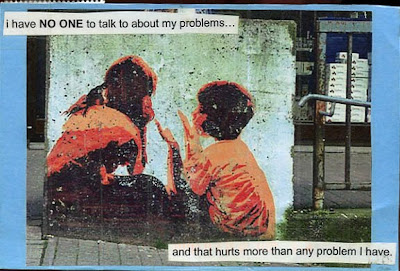
I was surprised to run into such a similar sentiment so soon. And I was struck by how hard it is to bring up a secret and share it with someone, but how freeing it can be if I manage to find someone I can share with.
It's not physical or emotional pain that will scar her; it's going through that pain alone.I think this is true of many painful situations, and part of my role as a chaplain is to help people not be as alone in the things they go through. But certain things are very hard to share, often because it doesn't seem socially acceptable to do so. Miscarriages and infertility seem to fall into that category, and therefore we have often felt alone as we have struggled through this process.
This morning on Post Secret I saw this:

I was surprised to run into such a similar sentiment so soon. And I was struck by how hard it is to bring up a secret and share it with someone, but how freeing it can be if I manage to find someone I can share with.
Thursday, December 3, 2009
Final Evaluation
CPE is more than just doing chaplain visits in a hospital. In fact CPE can be done in settings other than hospitals, though medical settings still seem to be the most common. But the main goals involve developing the person of the pastor, and helping the pastor become better suited to give care to other people. And one of the key ways this is done is by helping the pastor explore his-/her-self, and interpersonal interactions with other people. It can be hard to explain how this works, since it's pretty emotional, touch-feely, and relationship oriented, which I find are things that I have a hard time explaining in words.
The end of our first unit has arrived, and with the end of the unit comes the final evaluation. I thought maybe if I posted the questions that we have to answer, it may help reveal a bit of the process. Though they may need some clarification, so go ahead and ask!
The end of our first unit has arrived, and with the end of the unit comes the final evaluation. I thought maybe if I posted the questions that we have to answer, it may help reveal a bit of the process. Though they may need some clarification, so go ahead and ask!
- Give a brief biographical description of yourself
- State your progress toward your learning goals and the CPE Outcomes.
- How did you use your own religious heritage to minister in this setting? What new pastoral skills, resources or other religious traditions have been helpful? Include clinical material and critical incidents.
- Describe your ministry to patients and staff this unit. How did your presence affect them? What did you learn from them?
- State your understanding of how this experience has impacted your theology.
- Discuss your understanding of how your personal strengths and weaknesses are utilized in your ministry. How does your personal story (including your family background and relationships) impact your pastoral identity and ministry?
- What have you learned about yourself from each of your peers? Describe these relationships. How have you used your peer group for support, clarification and confrontation?
- Evaluate your relationship with your supervisor. How have you used supervision? What have you learned about the way you relate to authority figures?
- What are your future learning goals and how will you work toward your goals?
The goal is to give your evaluative impressions, ideas and feelings about each person including you and the supervisors. Please include your assessment of the strengths and weaknesses of each person. This can be done directly, or through the use of images or under the umbrella of "Blessings" and "Hopes" for each person. You may include what the person has meant to you and your learning or growth. Base your assessment on whatever context or ways that you have observed or experienced each person. Please share briefly how you have worked on your goals as part of your group evaluation.
Monday, November 16, 2009
Remember...
Tonight at the hospital there was a memorial service for all of the people who died on the palliative care unit in the past year. It was a nice service: ecumenical, short, but meditative and meaningful. As I was listening to all of the names listed off, I thought it was nice to remember people and how they were loved.
But then I looked around, and realized how many people were in the audience compared to how many people were on the list. And remembered that many people die alone, or with hardly anyone to remember them. Or perhaps something that happened during their life estranged everyone who knew them. So how did I know they were all loved? Maybe some of them weren't.
And then as I thought about that, I remember that I believe that there is someone to love everyone. Everyone has at least someone who loves them, even if they don't love that someone back. And that is the beauty of God's love: no one dies without Someone loving them.
So each of those names, even if I couldn't see someone in the audience, was loved. And it was a long list.
Thursday, November 12, 2009
The Hardest Part
I think the hardest part of being a chaplain, so far, is that it has become very difficult for me to deny the fact that I am going to die someday. So will my family, and friends. So will everyone. Very obvious, I know, we all know that everyone dies. It's part of life: you are born, you live, you die. That's just how it goes, and there are all kinds of cute sayings to remind us of the inevitability of death.
But at the same time I go through life not thinking about when I might die, and I don't think I'm alone in this. Spending every living moment thinking about how I could die, and what to do about it, does not seem to be a very pleasant way to live. So I go through life trying to pretend I'm invincible, along with most everyone else. We drive aggresively, making that lane change even when the sun is in our eyes and we might have missed the car there; or maybe we roll through that stop sign, not really paying attention to what or who we might risk hitting. We don't exercise and eat the food pyramid, because there will always be time later to recover from that extra hamburger. We avoid the doctor unless we really need to, because visiting the doctor admits we might not be invincible after all. We put off fixing relationships, or saying the things we think we need to say, because there will always be time later.
But then when we're perfectly healthy, we catch the flu or some other unexpected disease and end up in ICU, barely hanging on, and our family wonders what happened. Or we drop suddenly from a heart attack, or an aneurysm, or an embolism, or a clot, or a stroke, and it isn't when we're 95 and ready to go and even somewhat expecting it, but when we're out jogging at 35, having sex at 26, swimming at 18, sitting watching TV at 47. Or we get in a car accident, or an act of violence we never saw coming, or a building collapses, or some other accidental event that we were no part of and never thought would happen to us, but it does and that's the end for us. Or cancer shows up when we least expect it, turns our own cells into assassins, and destroys us before we could finish doing whatever it was we thought we wanted to do. Or we come to the hospital for a surgery, procedure, or medication to make us better, but for whatever reason we don't make it through and what should have been a simple trip to get better ends in a surprise funeral.
And just like that, life ends. There's no predicting it, and in the end there's no stopping it. The easiest thing to do, at least for me, is to not dwell on it too much. To try and live without regrets, to correct the things I have to, and to try and remember that I'm not actually invincible. But watching people die on a regular basis is the hardest thing for me as a chaplain, not because it's sad (though it is often that), but because it reminds me that though I may never see death coming, death might still be lurking right around the corner. And I often think that it would be easier if I didn't have to remember that.
How do you do it?
So far, in my few months as a hospital chaplain, a number of people have told me some variation of "I could never do what you do." Which is fine with me, because if everyone could do what I do then there wouldn't be much of a job market for me. But more importantly, there's plenty of things they do that I couldn't, or won't, do, so I think it's good we can't all do everything. I can't imagine cleaning up after people for a living (which is a lot of what nurses seem to do); or risking my life regularly (like firefighters); or any job where there is a serious chance of getting shot; or being on the road weeks at a time as a trucker (I told a husband of a patient that when he was telling me about his life away from home as a trucker, and he laughed since he had just said he couldn't do what I do).
Common corollary questions are "How do you do it?" or "Why do you do it?" I don't usually have a very good answer to either of those questions, partly because it doesn't often occur to me to ask those questions myself. Sometimes it does, so I do have some answers. As to "why," I do it because I think that's what I'm supposed to do. Simply put, I think God has asked me to do this. "Blessed are those who mourn, for they will be comforted." Perhaps sometimes it is people who are to do the comforting, not only the mourning, so I am here. Jesus said that visiting people who are sick is important. These days, visiting sick people has to include visiting people in the hospital, so I do that. Visit enough people in the hospital and you will be supporting people through the process of dying, so I do that too.
As to "how," that is a bit harder to answer. I do it with a lot of support from other chaplains, first. But something that a chaplain much wiser than me has said points out a key reason how I can do this: "Remember, it is their crisis, not yours." Very true. I can stand with a family and watch as their mother and grandmother slowly stops breathing over the course of a couple hours, and they have to struggle themselves to remember to breath, because she is not my mother, or my grandmother. I can sit through multiple attempts to revive someone when the children and lovers can't bear to watch and have to leave the room because I am not his child, and I am not her lover. I can handle watching people grieve over the inexplicable death of a child without it rending my own heart into minuscule pieces because he is not my son, and she is not my daughter. They are not my siblings, or family, or friends. In fact most of the people here I hardly know at all, and that is how I do it. I can empathize and support, and I can feel the sorrow and pain, but I can also reasonably step aside from it, because it is not my crisis. The people I support cannot do this, because it IS their crisis: to step aside would be to deny what is happening, and in the long run they will most likely be healthier if they face the pain and sorrow now than if they avoid it. It is precisely when I do have a stronger connection to the patients or their family and friends that it becomes much harder to do the task of chaplain. But those moments also help remind me of what it feels like, so in the end they are beneficial.
So I leave the hospital, and step away from it all at the end of the day. I think and pray about the people I serve, but I do not continue to grieve the same way they do. And I turn up the music and let it cue my emotions, and feel the release wash over me. And I remember that it's not my crisis after-all. That's how I do it.
Subscribe to:
Posts (Atom)